
Overview
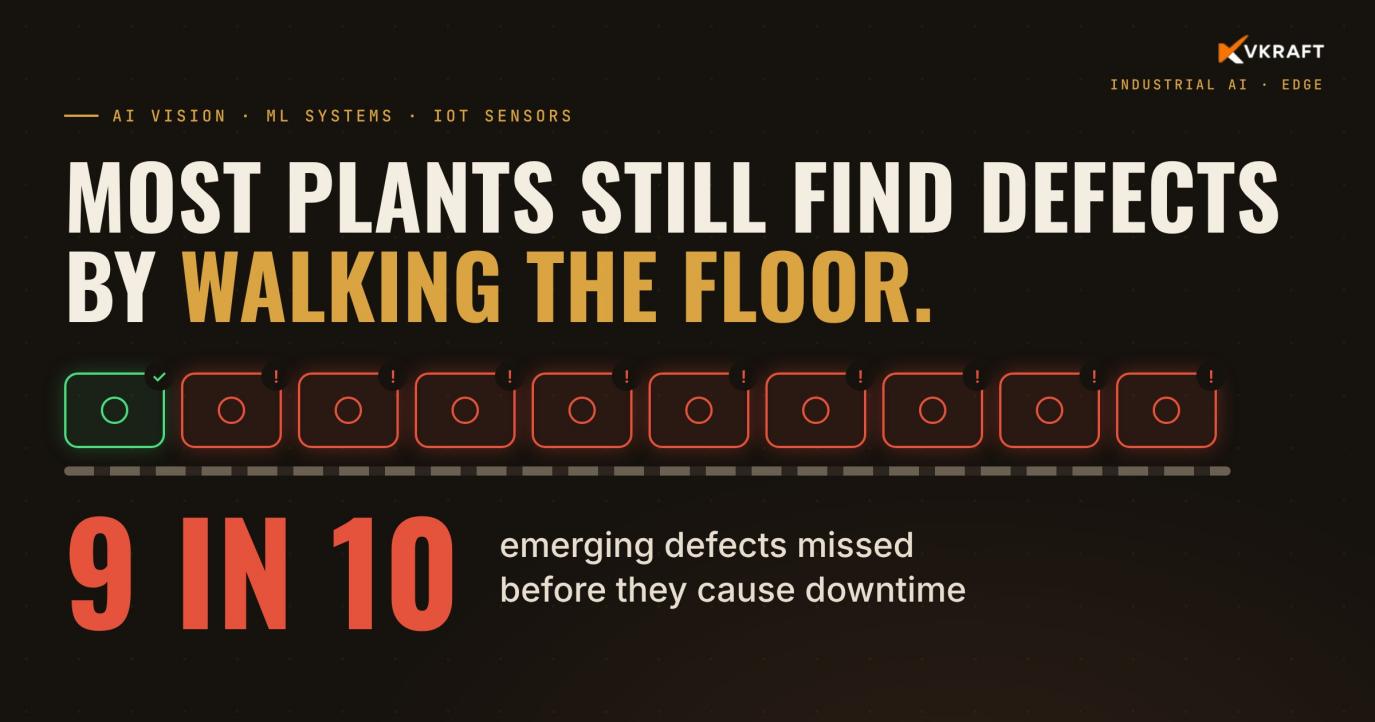
Most plants still find defects by walking the floor, and that approach misses 9 in 10 emerging defects before they cause downtime. VKraft connects vibration, temperature, gas and acoustic sensors with AI cameras that inspect every part at 30 frames per second. Edge models flag problems in under 10 milliseconds, and only insights and evidence move on to your cloud and dashboards.
The result is a single view of asset health, product quality and site safety, built on the PLC, SCADA and MES systems you already run. Typical deployments cut scrap by 42%, give more than 200 hours of warning before equipment failures and reduce unplanned downtime by 68%.
At a glance
| Highlight | Detail |
|---|---|
| −42% scrap | Typical reduction in scrap rate within six months in manufacturing. |
| 200+ hours | Median warning before rotating-equipment failures in oil, gas and energy. |
| 30 days | First dashboards go live within 30 days of kickoff. |
| Under 10 ms | Edge models classify anomalies locally, right next to the asset. |
| No rip-and-replace | Works with the PLC, SCADA and MES systems you already run. |
| 90-day checkpoint | KPIs are written into the statement of work (SOW), and impact is validated before you scale. |
The Challenge
Manual inspection cannot keep up with modern industrial throughput.
Industrial operations generate terabytes of sensor and camera data every hour. Yet most plants still rely on walkthroughs, periodic calibration and reactive maintenance, an approach that misses 9 in 10 emerging defects before they trigger downtime.
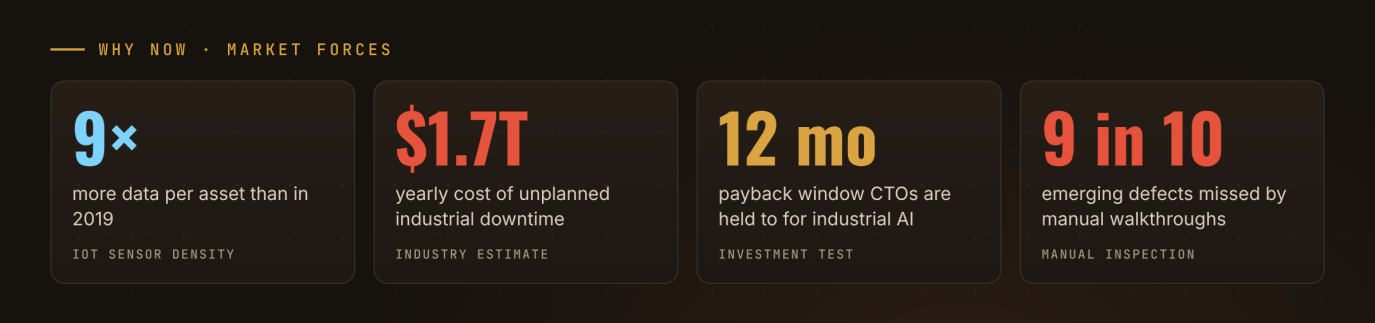
The pressure keeps rising. Each asset now produces 9× more data than it did in 2019, and unplanned downtime costs industry an estimated $1.7 trillion a year. CTOs and IT directors are expected to show safety, throughput and overall equipment effectiveness (OEE) gains from industrial AI within a 12-month payback window. AI vision and ML systems, deployed at the edge and connected to the existing IoT sensor fabric, are the most practical way to meet that bar.
IoT Sensor Layer
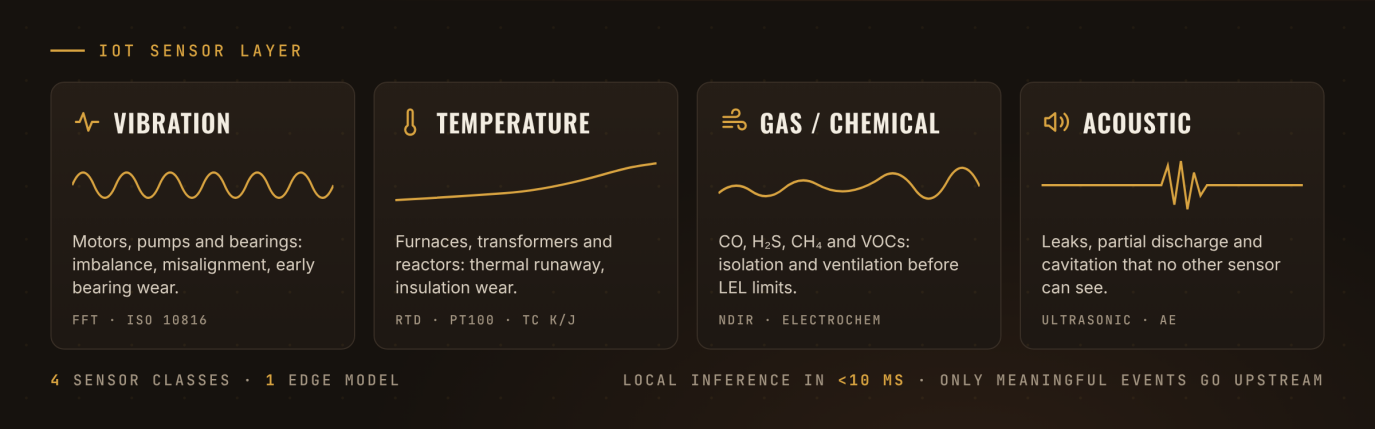
Every machine becomes a data source.
Vibration, temperature, gas and acoustic sensors stream continuous signals from rotating equipment, pipelines, furnaces and conveyors. Edge ML models classify anomalies locally in under 10 milliseconds and forward only meaningful events upstream.
Vibration
Accelerometers on motors, pumps and bearings detect imbalance, misalignment and early-stage bearing wear, often more than 200 hours before a failure. Analysis uses FFT and the ISO 10816 vibration standard.
Temperature
RTD and thermocouple arrays (PT100, type K and type J) on furnaces, transformers and reactors catch thermal runaway and insulation degradation in real time.
Gas and chemical
Electrochemical and NDIR sensors monitor CO, H₂S, CH₄ and VOC concentrations, and trigger isolation and ventilation before the lower explosive limit (LEL) is reached.
Acoustic
Airborne ultrasonic and acoustic emission sensors detect leaks, partial discharge and cavitation that no other sensor class can see.
AI Camera and Vision
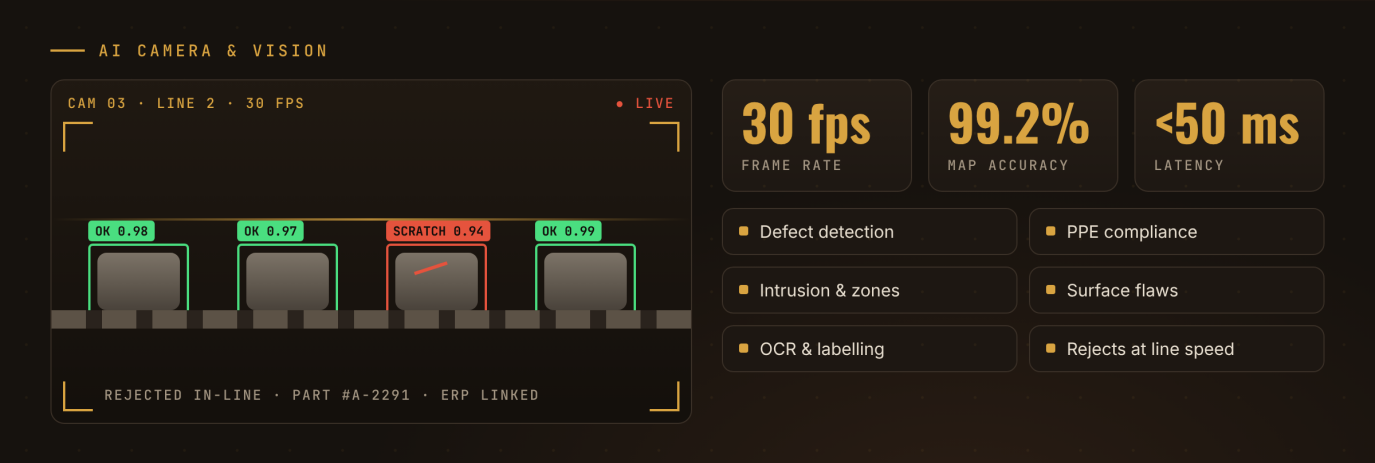
Turn every camera into a 24/7 inspector.
Industrial-grade AI cameras run deep-learning vision models at the edge, including YOLO-class detectors, segmentation networks and OCR engines, directly on the production line, gate or perimeter. They inspect every part at 30 frames per second with 99.2% mean average precision (mAP) and less than 50 milliseconds of latency. No frame leaves the site unless it carries an actionable insight.
Defect detection
Surface scratches, dents, mislabels and dimensional deviations on parts moving at 2 metres per second are classified and rejected in-line.
PPE compliance
Hard hats, high-visibility vests, gloves and safety glasses are verified at every entry zone, and violations are flagged to supervisors in under one second.
Intrusion and zone monitoring
Perimeter cameras with object tracking detect unauthorised people inside hazardous or restricted zones, day or night.
Surface flaws
Coatings, welds, paint and films are inspected for porosity, runs and colour drift beyond what the human eye can see.
OCR and labelling
Serial numbers, batch codes and expiry dates are read from curved or moving surfaces and matched automatically against ERP records.
Architecture
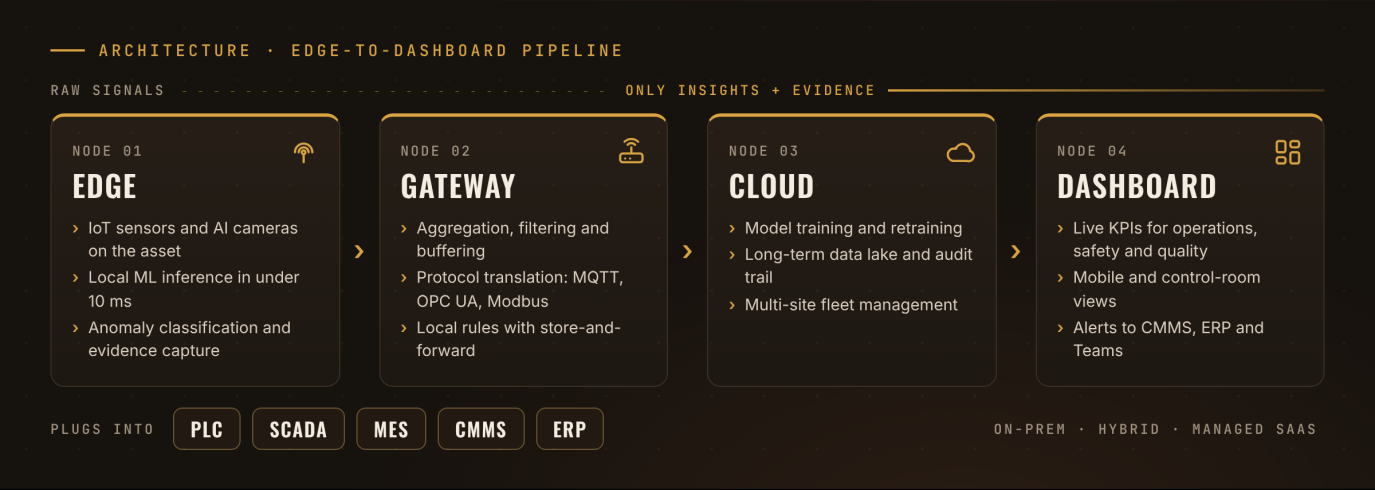
An edge-to-dashboard pipeline that moves only insights and evidence.
A four-stage pipeline of edge, gateway, cloud and dashboard protects latency, bandwidth and data sovereignty by processing raw signals as close to the asset as possible. At the edge, sensors and cameras run ML inference in under 10 milliseconds and capture evidence. The gateway aggregates, filters and buffers data and translates protocols such as MQTT, OPC UA and Modbus. The cloud handles model training, the long-term data lake, the audit trail and multi-site fleet management. Dashboards show live KPIs for operations, safety and quality, and send alerts to CMMS, ERP and Microsoft Teams.
The architecture is vendor-agnostic. It integrates with your existing PLC, SCADA, MES and cloud tenants, so nothing gets ripped out, and it can be deployed on-premises, as a hybrid or as a fully managed SaaS service.
Results You Can Measure
Less scrap, earlier warning and less unplanned downtime.
In manufacturing, scrap rates typically fall by 42% within six months of deployment. In oil, gas and energy, failures in rotating equipment are flagged a median of more than 200 hours before they happen, and unplanned downtime falls by 68%. Because the KPIs are written into the SOW, every result is measured on your own lines and assets, not taken from an industry average.
Industry Applications
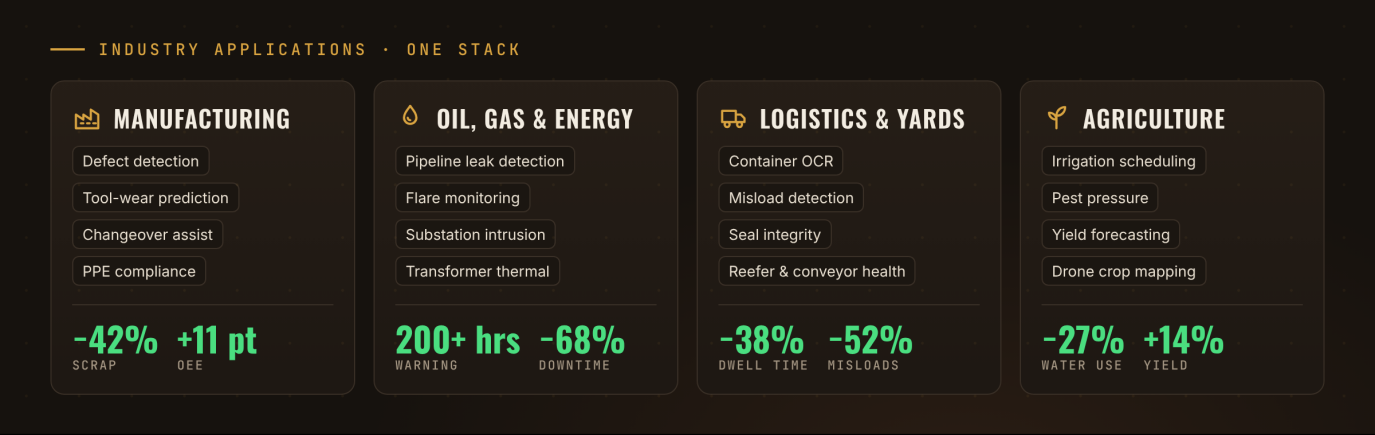
The same stack works across very different industries.
The sensors, cameras and edge models are the same everywhere. What changes is what they watch for and which systems they report into.
Manufacturing
AI cameras mounted over pressing, machining and packaging lines detect cosmetic and dimensional defects at line speed, replacing manual sampling with 100% automated inspection. Vibration and acoustic sensors on the same line predict tool wear and changeover timing. Quality becomes a data product rather than a sampling exercise, with an audit trail for every part shipped.
Typical results: 42% less scrap within six months, an 11-point OEE uplift after integration and 99.2% defect classification accuracy (mAP), with each camera inspecting 30 frames per second.
Oil, gas and energy
Refineries, pipelines and rotating equipment show failure signatures long before they fail. Vibration, gas and thermal sensors combine with AI cameras that read dial gauges and watch flare stacks in a single predictive model, giving maintenance crews hours or days of warning instead of seconds. For energy operators, the same stack covers substation intrusion, vegetation encroachment under transmission lines and transformer thermal anomalies without sending out a crew.
Typical results: a median of more than 200 hours of warning before rotating-equipment failures, 68% less unplanned downtime, 24/7 perimeter surveillance with no crew dispatch and an average of $4.2M in avoided cost per major incident.
Logistics, yards and warehouses
AI cameras at gates and dock doors read container numbers, detect misloads and verify seal integrity. IoT sensors on refrigerated units and high-bay conveyors predict failures before they disrupt cross-dock windows.
Typical results: 38% shorter dwell times, 99.7% OCR accuracy and 52% fewer misloads.
Agriculture
Soil moisture, weather and canopy sensors feed ML models that schedule irrigation, detect pest pressure and forecast yield. Drone-mounted AI vision maps crop stress across thousands of acres in a single pass.
Typical results: 27% less water use, 14% higher yield and 2,000 acres mapped in one pass.
What Changes for Your Teams
Each team gets the signals it needs, in the tools it already uses.
| Team | What changes |
|---|---|
| Operations | Live KPIs for throughput, quality and OEE in control-room and mobile views, instead of end-of-shift reports. |
| Maintenance | Early warning of bearing, motor and pump failures, with alerts raised directly in the CMMS. |
| Quality | Every part inspected at line speed, with image evidence and an audit trail for each part shipped. |
| Safety | PPE checks at every entry zone and alerts for people in restricted areas, flagged to supervisors in under one second. |
| IT and OT | A vendor-agnostic architecture that processes raw data at the edge and connects through MQTT, OPC UA and Modbus. |
How an Engagement Runs
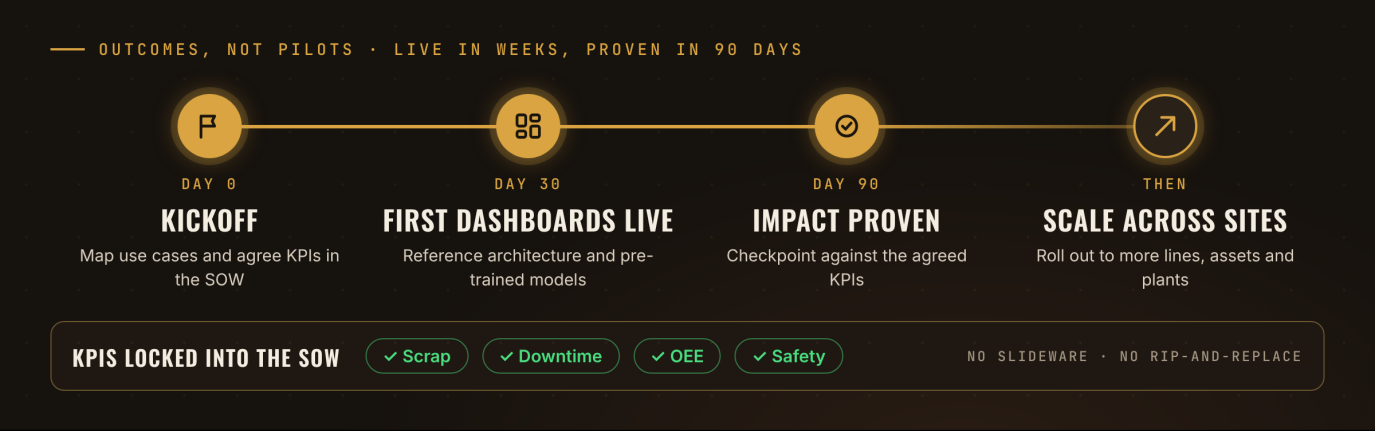
Live in weeks. Proven in 90 days.
Every engagement starts from reference architectures, a pre-trained industrial model catalogue and certified edge hardware, so the first dashboards go live within 30 days of kickoff. KPIs for scrap, downtime, OEE and safety are written into the SOW on day one, and a 90-day checkpoint confirms the impact before you scale to more lines, assets or sites.
Why VKraft
Industrial AI, built by people who have run the plant floor.
VKraft delivers edge-to-cloud AI vision and ML systems that integrate with your existing PLC, SCADA, MES and cloud tenants. They deploy in weeks, not quarters, with measurable OEE and safety outcomes written into the SOW.
Deploy in weeks
Reference architectures, a pre-trained industrial model catalogue and certified edge hardware put the first dashboards live within 30 days of kickoff.
Integrates with what you have
Native connectors for Siemens, Rockwell, AVEVA, SAP and the major cloud platforms mean there is no rip-and-replace and no new protocol to learn.
Outcomes, not pilots
Every engagement ships with KPIs written into the SOW, covering scrap, downtime, OEE and safety, and a 90-day checkpoint to validate impact before you scale.