
Overview
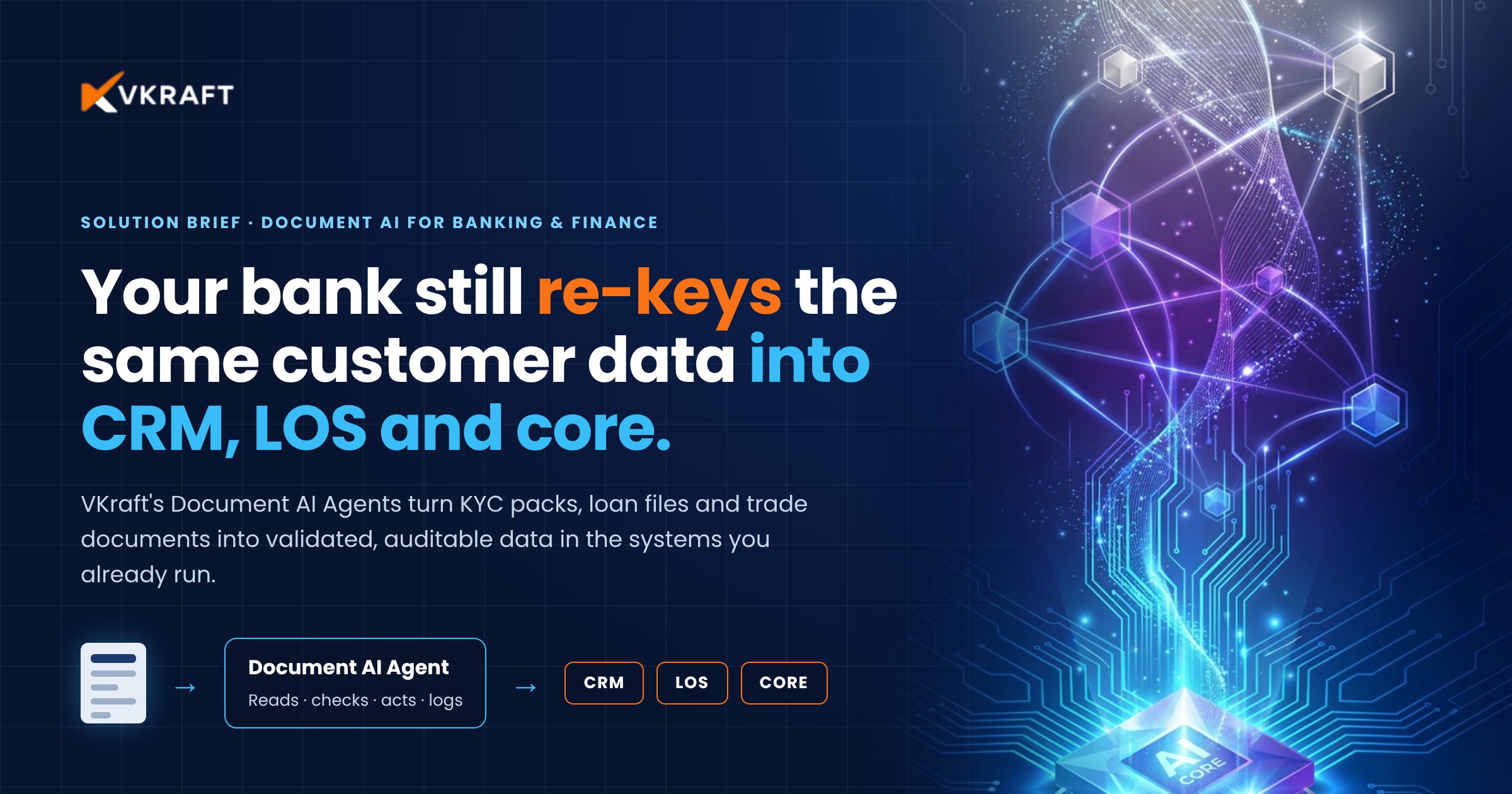
Your bank still re-keys the same customer data into CRM, LOS and core.
From KYC packs to loan files and trade documents, VKraft builds Document AI Agents that turn unstructured documents into validated, auditable data in the systems you already run.
At a glance
| Highlight | Detail |
|---|---|
| 4–6 weeks | A measured pilot on your own documents, with a go/no-go decision at the end. |
| ISO/IEC 27001 | Certified delivery for information security. |
| Private deployment | Runs in your cloud tenancy or data centre. Documents never leave the bank. |
The Challenge
Banks run on documents, and most of that work is still manual.
Loan files, KYC packs, trade confirmations, claims, invoices and regulatory returns arrive as PDFs, scans and email attachments. Operations teams read them, key the data, check it, and then key the same data again into the next system. The work takes days, mistakes creep in, and nobody can audit it at scale.
Re-keyed: the same data in many systems
Customer data is typed separately into CRM, the loan origination system (LOS) and core banking. Every copy is another chance for a mismatch.
Queued: days, not minutes
KYC and loan files wait for checks at every hand-off. Teams cannot hire fast enough to keep pace with document volume.
Unreadable: legacy scans
Archived documents are stored as images that no system can search, so every review starts with a person opening a file.
Untraceable: no decision trail
Approvals cannot be traced back to the source page. Keying errors surface weeks later in audits or customer complaints.
The business impact
- Throughput ceiling: Operations teams cannot hire fast enough to match the growth in document volume.
- Error and rework: Keying mistakes surface weeks later, in audits or customer complaints.
- Audit blind spot: Without structured metadata, regulators cannot trace decisions back to the source documents.
We do not quote industry averages for these problems. In week 1 of a pilot, we measure turnaround, error and rework rates on your own documents, and those figures become the baseline.
The Approach
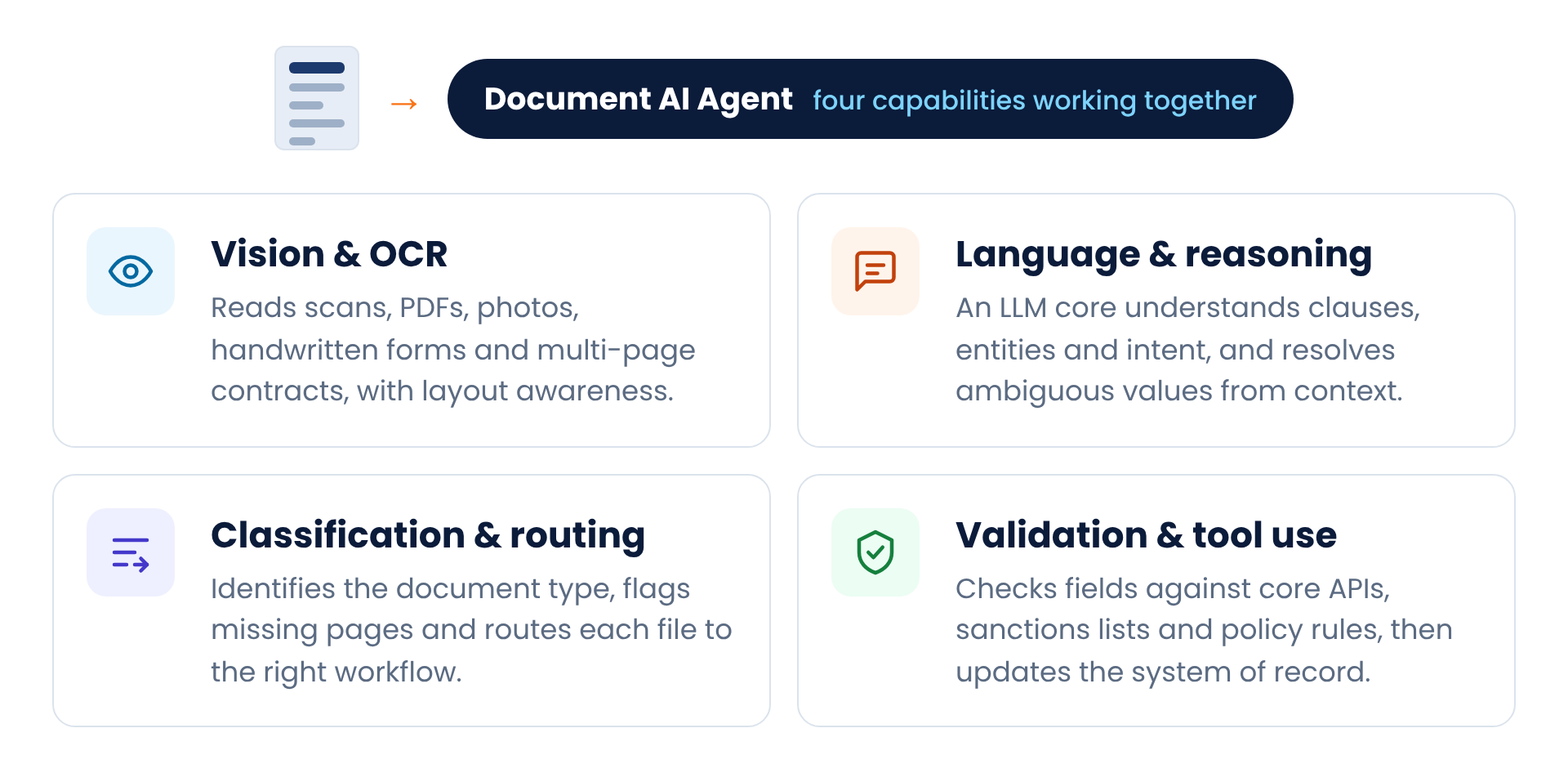
A Document AI Agent reads, understands and acts on documents from end to end.
It is more than OCR. A Document AI Agent combines vision, language, classification, retrieval and tool use. It takes in an unstructured document, extracts structured fields, validates them against business rules, decides which exceptions need a person, and pushes the result into downstream systems with a full audit trail.
Architecture
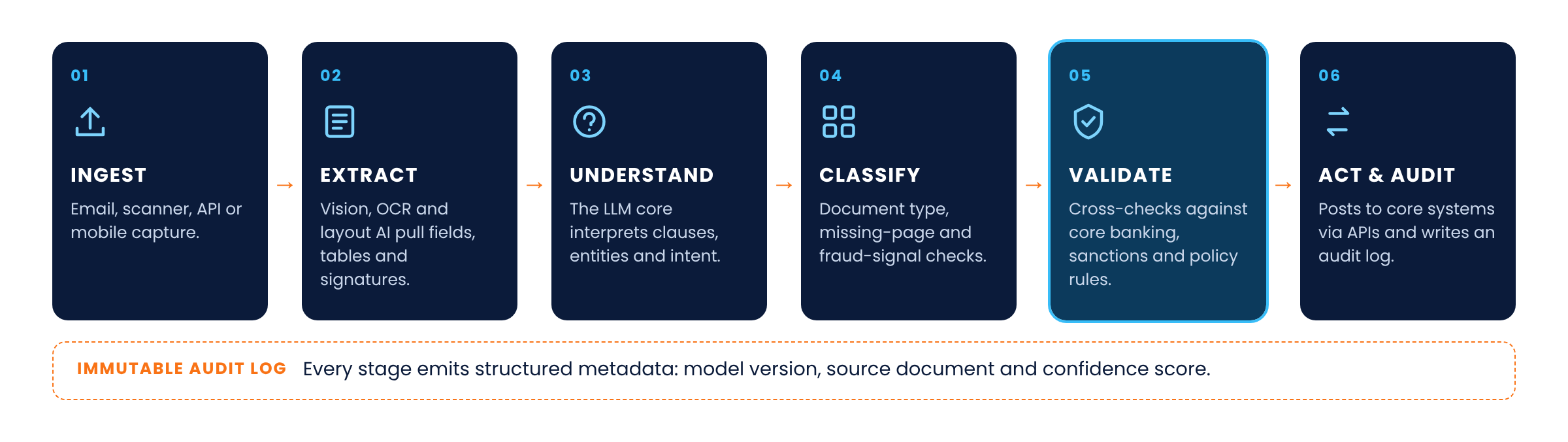
A layered pipeline, from raw document to audited action.
Each stage emits structured metadata, and that metadata becomes the audit record. Stages scale independently and can be replaced individually, so a bank can adopt one layer at a time.
Platform foundations
- Models: Azure OpenAI or a privately hosted LLM, with layout-aware OCR and document classifiers.
- Retrieval: A vector index over policy manuals, product specifications and prior decisions, so answers are grounded in your own material.
- Deployment: Your cloud tenancy, on-premises or hybrid. Documents stay inside the bank's boundary.
The Audit Trail
Every step is logged, so regulators can follow each decision.
Each extraction, classification and downstream action is recorded with the model version, the source document and a confidence score. Low-confidence results go to a reviewer instead of straight through. The table below shows an illustrative audit log for a corporate KYC file.
| Action | Field or record | Result |
|---|---|---|
| Extract | Beneficial owner | Logged |
| Validate | Sanctions list check | Logged |
| Classify | Board resolution | Sent for human review |
| Act | Posted to core banking | Hashed and logged |
Integration
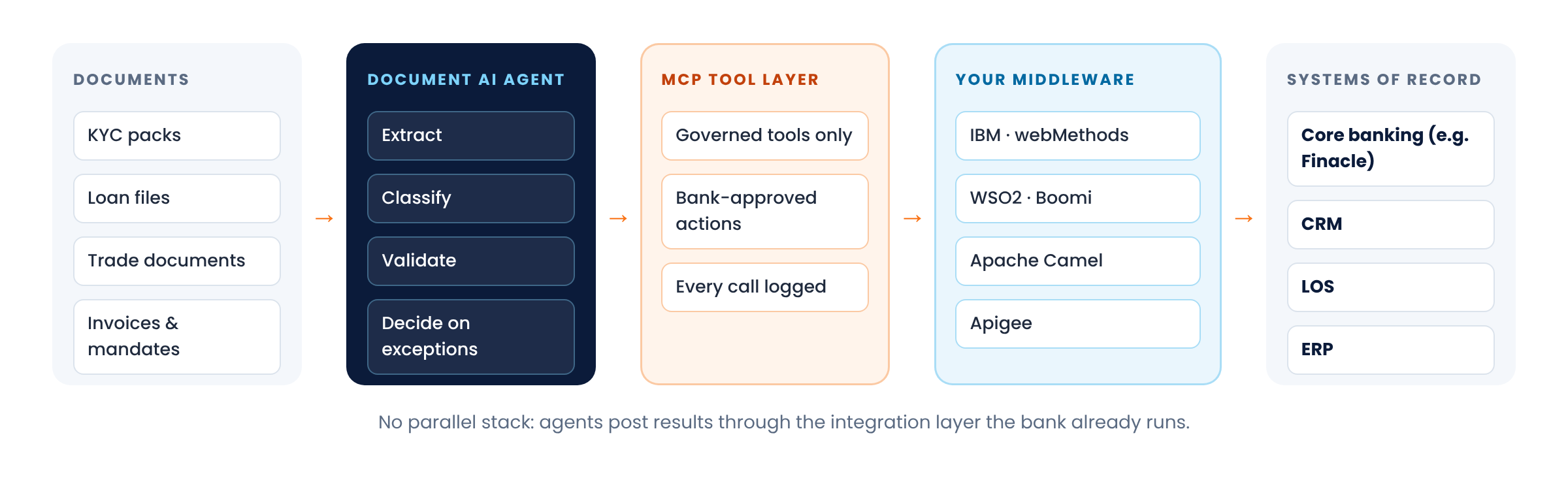
Results go through the integration layer you already run.
Agents post their output through your existing middleware, such as IBM, webMethods, WSO2, Boomi, Apache Camel or Apigee, rather than through a parallel stack. Core systems such as Finacle are reached through their APIs, and a Model Context Protocol (MCP) layer exposes governed tools to the agent, so it can call only what the bank has approved.
Use Cases
Six workflows where documents slow the bank down today.
Each workflow can be deployed as a standalone module and connected to your existing core.
| Workflow | What the agent does | What we measure |
|---|---|---|
| KYC and onboarding | Ingests ID, proof of address, corporate filings and beneficial-ownership documents. Extracts fields, screens against sanctions lists and routes exceptions to compliance. | Onboarding time |
| Loan origination | Reads payslips, bank statements, appraisals and tax returns. Reconciles them with the application and flags discrepancies before underwriting. | File turnaround |
| Accounts payable | Captures vendor invoices, purchase orders and goods received notes. Runs the three-way match, codes to the general ledger and posts to the ERP without manual keying. | Straight-through rate |
| Account servicing and mandates | Reads board resolutions, mandate letters and signature cards. Updates authorised signatories and flags mismatches against the core. | Request turnaround |
| Regulatory reporting | Extracts positions and counterparty data for BNM, Basel and AML returns, with the source document linked to every reported number. | Source traceability |
| Trade finance and letters of credit | Parses letters of credit, bills of lading and inspection certificates, and flags UCP 600 discrepancies before a checker sees the file. | Document-check effort |
Compliance and Security
Built for regulated environments, where every decision is explainable.
Document AI Agents run inside the bank's trust boundary. Every extraction, classification and downstream action is logged with the model version, the source document and a confidence score.
Operating principles
- Private deployment: Runs inside your virtual private cloud, on-premises or hybrid. No document or model traffic leaves the bank's network.
- Immutable audit trail: Every field, decision and tool call is timestamped, hashed and replayable for regulators.
- Model governance: Pinned model versions, drift monitoring and human review of low-confidence cases by default.
- Data residency: Region-locked storage and processing in Malaysia, Singapore, India or wherever your regulator requires.
Certifications and frameworks
| Standard | Scope | Status |
|---|---|---|
| ISO/IEC 27001 | Information security management | Certified |
| ISO 9001 | Quality management | Certified |
| ISO 37001 | Anti-bribery management | Certified |
| PDPA 2010 | Malaysia's Personal Data Protection Act, plus local equivalents | Controls mapped in design |
| BNM RMiT | Bank Negara Malaysia: Risk Management in Technology | Controls mapped in design |
| MAS TRM | Monetary Authority of Singapore: Technology Risk Management Guidelines | Controls mapped in design |
Pilot Blueprint
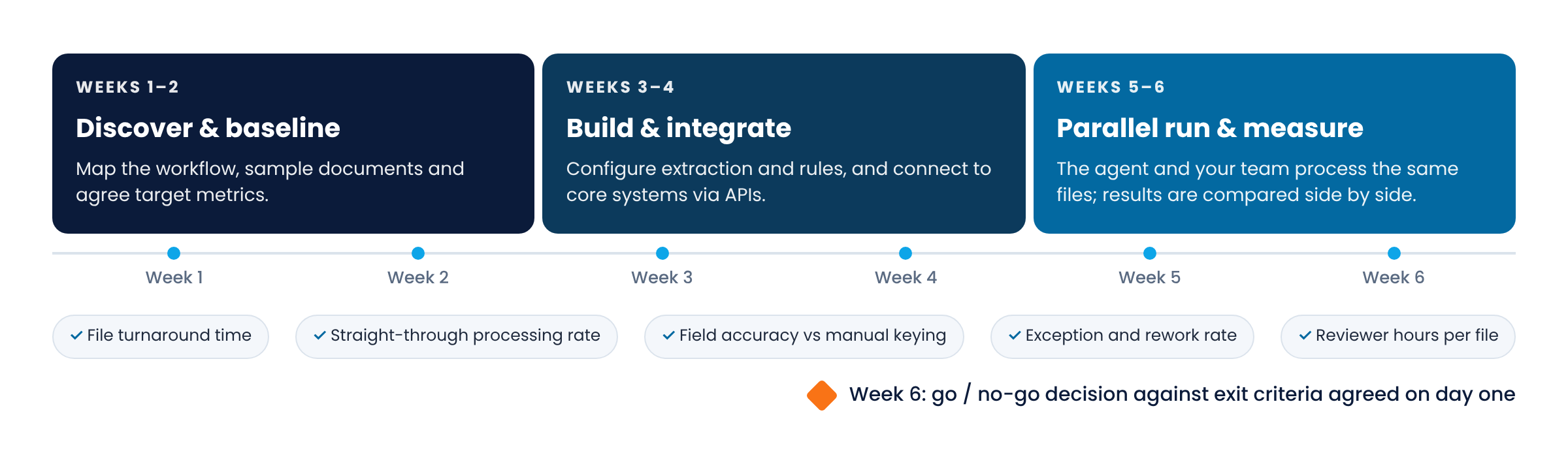
A six-week pilot, measured on your own documents.
We start with one high-volume workflow, such as corporate re-KYC or loan files. Your team sets the baseline and the success criteria in week 1, and the agent runs alongside your operations staff before anything goes live.
Why VKraft
Banking integrations are our native language.
We build and run integration and API platforms for enterprises in Malaysia, Singapore, India, the UK and the USA. Document AI is the next layer on top of the cores, partner APIs and payment rails you already operate.
Integration-first
Agents post results through the integration layer that already runs your bank: IBM, webMethods, WSO2, Boomi, Apache Camel or Apigee. Cores such as Finacle are reached through their APIs, with MCP exposing governed tools to the agent. There is no parallel stack.
Your models, your tenancy
We build on Azure OpenAI or a privately hosted LLM inside your cloud tenancy or data centre, so you keep model choice and data control. Accuracy is tuned and measured on your own documents during the pilot, not promised upfront.
Proven integration track record
| Industry | Client outcome |
|---|---|
| Retail | Moved thousands of legacy integration endpoints to Apache Camel and Apigee, cutting $1.5M from annual licensing costs. |
| Insurance | Built an API and caching layer so core systems moved to the cloud without rewriting the applications underneath. |
| Telecoms | Halved monitoring costs while keeping 24×7×365 cover. |
| Automotive | Automated SAP-to-HR data transfer with Boomi, so nobody re-keys employee data. |